Radon Fredericksburg VA: What Homeowners Should Know
Radon Fredericksburg VA homeowners rarely think about, mostly because it’s invisible no smell, no color, no taste, nothing that tips you off without testing for it. That’s exactly why it’s worth a few minutes of attention, especially if you’re in Spotsylvania or Stafford, where the risk profile is higher than in surrounding areas.
What Radon Actually Is
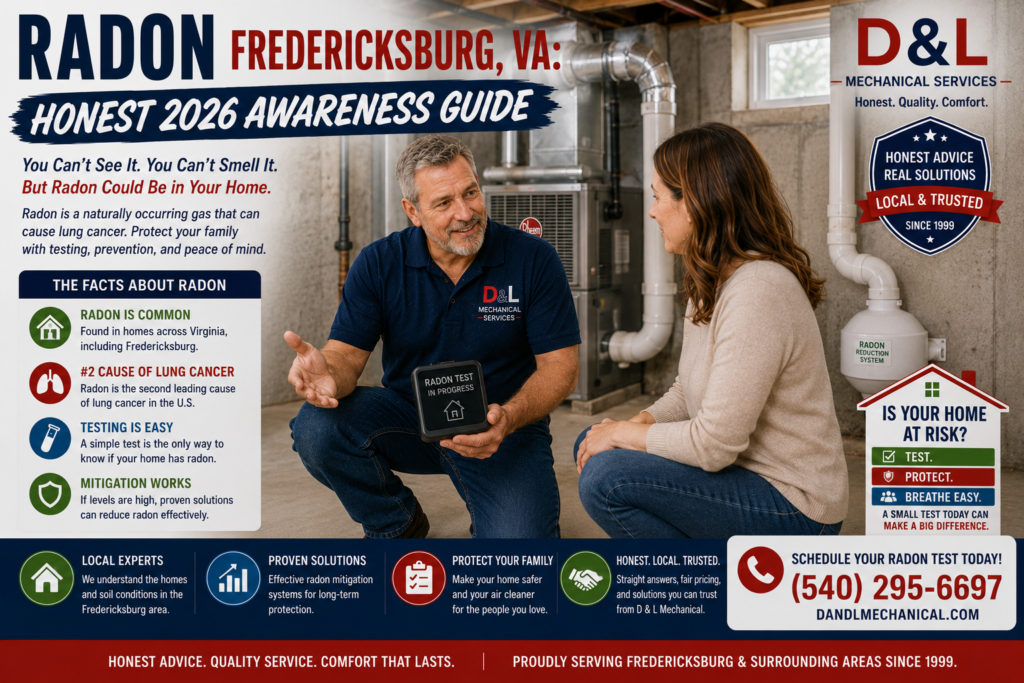
Radon is a naturally occurring radioactive gas that comes from the breakdown of uranium in soil and rock. It seeps up through the ground and can enter homes through foundation cracks, crawlspaces, and other openings. According to the EPA, radon is the second leading cause of lung cancer in the United States, after smoking. It’s not rare, it’s not exotic it’s just invisible, which is the whole problem.
Why Spotsylvania and Stafford Homeowners Should Pay Extra Attention
Radon risk isn’t evenly distributed. Both Spotsylvania and Stafford counties fall into the EPA’s highest radon potential zone (Zone 1), meaning homes in these areas are statistically more likely to test above the EPA’s action level of 4 picocuries per liter (pCi/L) than the national average. King George and Caroline counties fall into a lower-risk zone by comparison.
That said, it’s worth being honest about what this zone map actually tells you: it’s a county-level average based on data collected decades ago, not a prediction for your specific house. The Virginia Department of Health is direct about this homes with elevated radon have been found in every Virginia county, including ones labeled “low risk.” Radon Fredericksburg VA risk really comes down to your specific home, not just which side of a county line you’re on. You can see the Virginia radon zone map and more detail directly from VDH if you want to look up your specific area.
How Radon Gets Into Your Home
Radon typically enters through the path of least resistance foundation cracks, gaps around pipes, sump pits, and crawlspaces. If you read our post on crawlspace humidity in the Fredericksburg area, a lot of the same structural gaps and openings that let moisture into a crawlspace can also be entry points for radon. They’re not the same problem, but they often share the same underlying vulnerability: a home’s connection to the ground beneath it isn’t as sealed as it should be.
How Your HVAC System Plays a Role
Your HVAC system doesn’t cause or fix a radon problem on its own, but it does affect how air moves through your home, which can influence radon levels. Poor ventilation and negative air pressure (common in tightly sealed, energy-efficient homes) can sometimes pull more soil gas into the house. This is one more reason we think about whole-home air quality holistically ventilation, humidity, and air exchange all interact with each other, even though each has its own separate causes and fixes.
Getting Tested
Testing is simple and inexpensive, and it’s the only way to actually know your home’s radon level you cannot tell by smell, symptoms, or how old or new your home is. You have two basic options:
DIY test kits: inexpensive, available online or at hardware stores, and reasonably accurate for a first check
Professional testing: more precise, useful if you’re buying or selling a home, or if a DIY test comes back elevated and you want confirmation
If your home tests at or above the EPA’s action level of 4 pCi/L, the next step is radon mitigation typically a sub-slab depressurization system installed by a licensed radon mitigation specialist. This is a specialized trade separate from general HVAC work, and we think it’s important to be straightforward about that rather than pretend it’s something any HVAC company can handle. If you test high, we’re happy to point you toward a properly licensed radon mitigation contractor for that specific piece of the work.
Why We're Bringing This Up
We could easily leave radon out of our content entirely it’s not something we install or fix, so there’s no direct sales angle here. But the same price vs. cost thinking applies: a $15-$30 test kit today is a lot cheaper than finding out about a radon problem the hard way, years down the road. We’d rather you know about radon Fredericksburg VA risk from us, honestly and with no pressure, than not hear about it at all.
Questions About Your Home's Air Quality?
If you’re dealing with broader indoor air quality questions humidity, ventilation, or anything HVAC-related give D and L Mechanical Services a call at 540-295-6697. For radon testing and mitigation specifically, the EPA’s directory above is the best place to start.