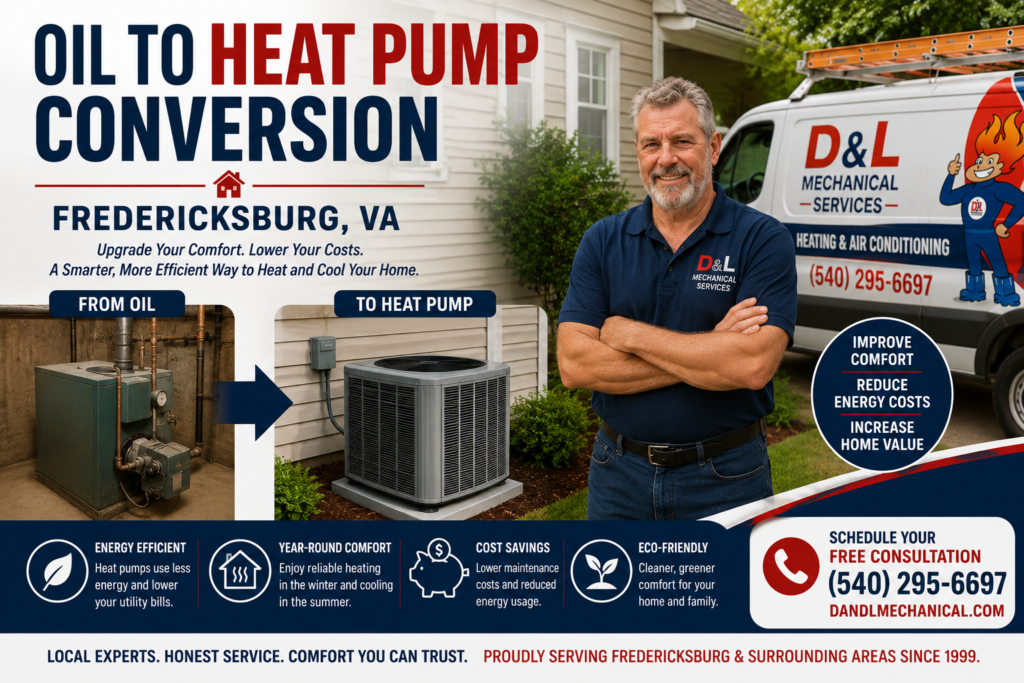
Oil to Heat Pump Conversion Fredericksburg VA: 2026 Costs
Oil to Heat Pump Conversion Fredericksburg VA: What to Expect in 2026
Oil to heat pump conversion Fredericksburg VA homeowners are considering has become a lot more common lately — and for good reason. Between rising oil prices, aging tanks and furnaces, and heat pump technology that now performs well even in our regional winters, more people in the older and rural parts of the Fredericksburg area are asking whether it’s time to make the switch.
Why Fredericksburg-Area Homeowners Are Switching From Oil to Heat Pumps
A lot of homes in and around Fredericksburg — especially older properties and rural homes outside the more recently built subdivisions — were originally built with oil heat, often because natural gas wasn’t available in the area. Oil heating has real downsides that heat pumps don’t share:
Fuel cost volatility: oil prices swing more than electricity rates, and tank refills come in large, unpredictable lump sums
Aging equipment: many oil furnaces and tanks in the area are decades old and nearing the end of their realistic lifespan
No cooling function: an oil furnace only heats; a heat pump handles both heating and cooling in one system
Tank maintenance and risk: old oil tanks (especially underground ones) can leak, corrode, or require costly removal down the road
An oil to heat pump conversion Fredericksburg VA homeowners choose typically eliminates all four of these headaches at once.
What Does Oil to Heat Pump Conversion Cost in Fredericksburg, VA?
Conversion costs vary more than a straightforward like-for-like replacement, since the project usually involves more than just swapping equipment. For a typical Fredericksburg-area home, an oil to heat pump conversion Fredericksburg VA project generally runs $13,000 to $17,000, depending on two main factors:
Ductwork: whether your existing ductwork is compatible with a heat pump as-is or needs modification or replacement
Old oil tank removal: decommissioning or removing your existing oil tank, which varies significantly depending on whether it’s above-ground or underground
On top of those two big variables, the project may also need electrical panel or circuit upgrades, since heat pumps run on electricity rather than oil. Given current 2026 equipment and installation costs across the industry (we cover the numbers in detail in our HVAC cost guide), we’ll always walk you through exactly where your home falls in that range and why before you commit to anything.
Is Your Home a Good Candidate for Conversion?
Not every oil-heated home converts the same way. A few signs your home may be a strong candidate:
Your oil furnace or tank is aging and due for replacement anyway
You already have (or are open to adding) ductwork compatible with a heat pump system
You’re tired of budgeting for unpredictable oil deliveries
You want air conditioning added to a home that currently only has heat
Homes with unusual layouts, no existing ductwork, or older electrical systems can still convert it just means a more involved evaluation, which is exactly what we walk through during an in-home visit.
Why You Can't Just "Match the BTUs" From Your Old Oil Furnace
This is the part almost nobody explains clearly, and it’s where a lot of oil to heat pump conversions go wrong when handled by someone who doesn’t take the time to do it right: there is no direct BTU-for-BTU equivalent between an oil furnace and a heat pump.
Part of the reason comes down to a basic difference in how the two appliances actually work: an oil furnace is a direct heat appliance, while a heat pump is an indirect heat appliance. An oil furnace burns fuel directly to generate heat on the spot. A heat pump doesn’t generate heat by burning anything — it moves existing heat from outside air into your home (and reverses that process to cool it in summer). That’s a fundamentally different mechanism, and it’s a big part of why the two systems can’t simply be sized by matching output numbers.
If your oil furnace is rated at, say, 100,000 BTUs, that number does not tell us what size heat pump to install. Here’s why:
An oil furnace’s BTU rating is a fixed, single output number — it burns fuel and produces heat at essentially one rate, regardless of outdoor conditions.
A heat pump’s heating capacity changes with the outdoor temperature. A heat pump rated for a certain heating output at 47°F outside puts out meaningfully less heat at 17°F — the colder it gets, the harder the system has to work, and its output capacity actually drops. Oil furnaces don’t behave this way at all.
Oil furnaces are also very commonly oversized to begin with. It was standard practice for decades to install an oversized furnace “just in case,” so your old furnace’s rated output may not even reflect what your home actually needs to stay warm.
Because of this, simply installing a heat pump sized to “match” your old furnace’s BTU rating can leave you with a system that’s either undersized for our coldest winter days (leaving you cold exactly when you need heat most) or oversized (short-cycling, higher energy bills, and uneven comfort). Neither is a good outcome, and neither shows up as a problem until months after installation — which is exactly why we don’t rely on the old equipment’s rating at all.
Instead, proper sizing for an oil to heat pump conversion Fredericksburg VA homes need requires a real Manual J load calculation — an assessment based on your home’s actual square footage, insulation, windows, orientation, and air leakage, not the size of whatever was installed decades ago. It’s an extra step, but it’s the difference between a heat pump that keeps you comfortable through a Virginia winter and one that leaves you disappointed.
Comfort and Efficiency: What Actually Changes
Modern heat pumps have come a long way from older, less efficient models. For most well-matched Fredericksburg-area homes, an oil to heat pump conversion means more consistent temperatures room-to-room, quieter operation than an aging oil furnace, and — since the same system handles cooling too — no separate AC unit to maintain. The U.S. Department of Energy has published detailed guidance on how heat pumps work and their efficiency advantages if you want to dig into the technical side.
What the Conversion Process Actually Looks Like
In-home evaluation: we assess your current oil system, ductwork, electrical capacity, and home layout
Tank plan: decide whether the oil tank is removed, decommissioned in place, or (for above-ground tanks) simply disconnected
Installation: the heat pump system goes in, along with any needed electrical or ductwork updates
Walkthrough: we make sure you understand how your new system works before we leave
Why Work With D and L Mechanical for Your Conversion
Darren Billington has spent over 30 years working on HVAC systems throughout the Fredericksburg area, including plenty of oil furnaces along the way — this isn’t a new or unfamiliar project type for us. If you’re weighing an oil to heat pump conversion Fredericksburg VA option for your own home, we’ll give you a straight answer about what your specific house needs, not just a generic sales pitch. Our oil furnace repair and heating repair pages have more on what we handle in the meantime, if your oil system just needs to make it through one more season first.
FAQ
Q: How much does oil to heat pump conversion cost in Fredericksburg, VA? A: A typical whole-home conversion runs $13,000–$17,000, depending mainly on ductwork condition and whether the old oil tank needs removal.
Q: Can I just match my oil furnace’s BTU rating to size a new heat pump? A: No. Oil furnaces produce direct heat at a fixed output; heat pumps move heat and their output changes with outdoor temperature. Proper sizing requires a real load calculation, not a BTU-for-BTU swap.
Q: What happens to my old oil tank? A: It can be removed or decommissioned in place, depending on whether it’s above or below ground this is factored into your quote.
Q: Will a heat pump keep my home warm enough in winter? A: Yes, when properly sized for our climate. This is exactly why load calculations matter more than matching old equipment ratings.
Ready to Talk Through Your Options?
Call D&L Mechanical Services at 540-295-6697, and we’ll walk you through what an oil to heat pump conversion would actually look like — and cost — for your specific home.